
By Nicole Hayes, Summer 2026 / FOCAS Intern 25-25 / University of Arizona
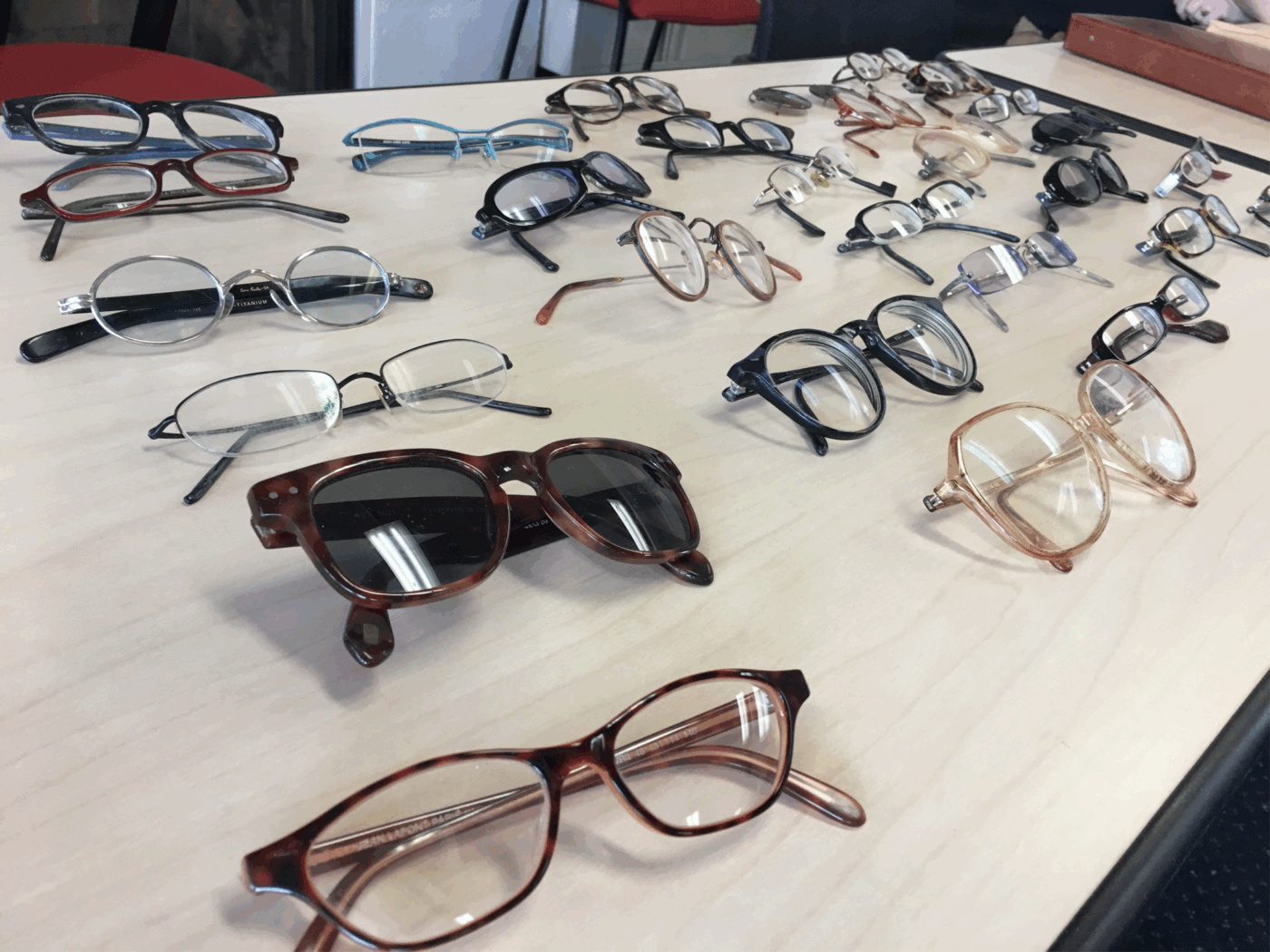
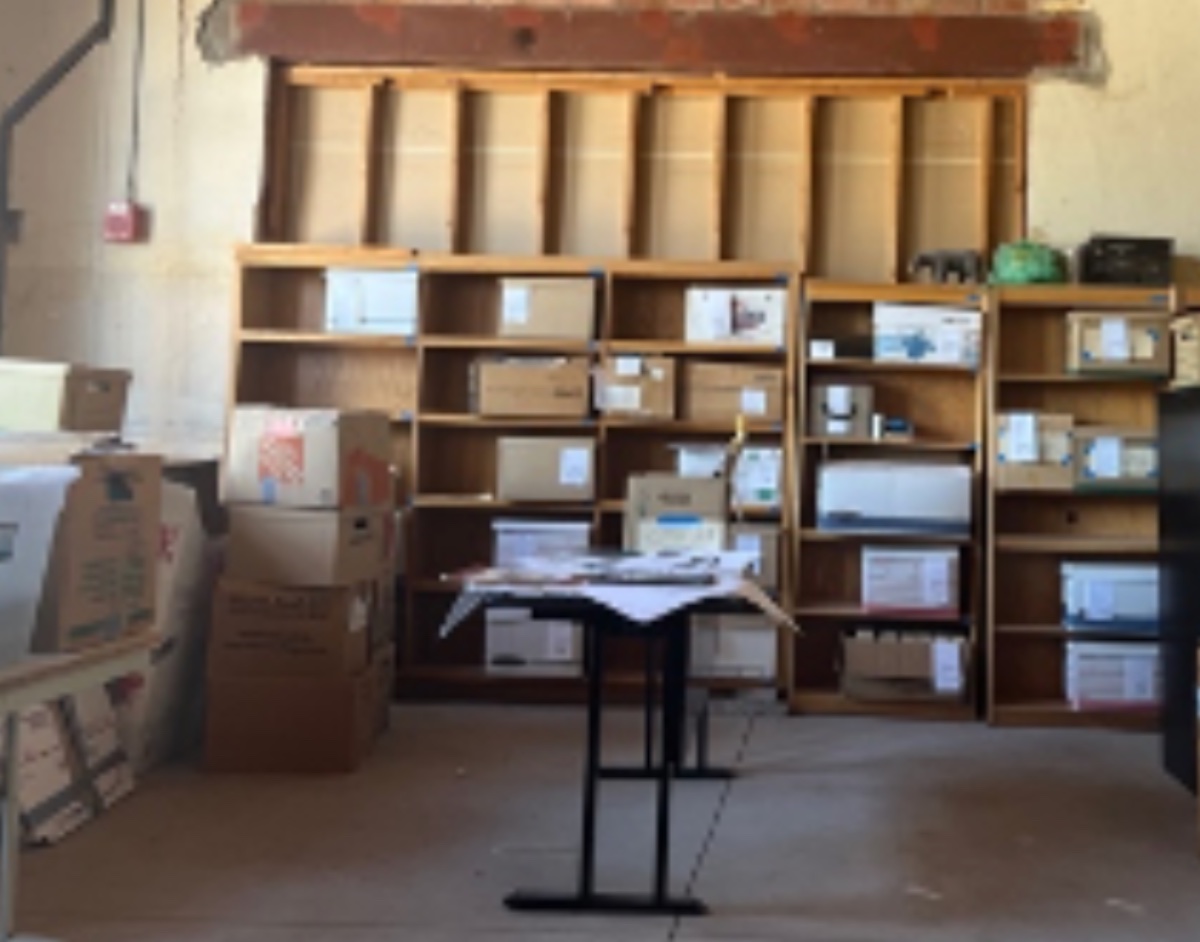
I first encountered Arizona Queer Archives in the Spring of 2024 at the very start of my MLIS program, thanks to an elective digital curation and preservation course. Oddly enough I wasn’t all that sure I wanted to take the course at first, but it ended up having a pretty formative impact on how I see the broader field of information sciences, and introduced me to the tools and critical thinking skills I needed to navigate it. The professor of this course often shared real world examples of preservation being done across GLAMs institutions and provided us hands on assignments to help us think through supporting access. One of our assignments required us to access an online repository, examine the metadata of a collection, and perform a subsequent risk assessment. I chose P. Carl’s Eyeglass collection from the AQA. The image metadata revealed they were taken on an iPhone on UA campus—a building I now know to be the transitory space where the AQA’s materials had been temporarily stored at the time, inaccessible to the general public.
The following semester I enrolled in a class with Dr. Jamie A. Lee. Again, my schedule was already full, and I almost dropped the class. However, I decided to show up on the first day, just to check it out. I changed my mind within the first five minutes of the lecture. It was here that I was introduced to foundational theory surrounding community archives discourse. Later that Fall, I applied for the FOCAS internship and was hired as an intern at the Arizona Queer Archives, where I’ve worked for the last three semesters.
My internship at the AQA enhanced my coursework by contextualizing it within the non linear work of an archivist. Throughout my tenure I spent time processing collections, assisting with collection management, curating exhibitions, and digitizing collections. I also found myself honing new skills in graphic design and community outreach, part of which meant enhancing accessibility through using collection materials to draw people in. My colleagues and I often used scans of collection items when making fliers. We also put together a few “visual guides” as an alternative to traditional finding aids.
The last two semesters I began digitizing materials, and found myself having to learn how to think like a photographer. I had some previous experience dabbling in photography as a teenager, but I’d never taken a professional photography course so my early attempts at digitizing materials proved challenging, yet rewarding. While learning, I had the opportunity to assist a design student in creating new postcards for the AQA by curating a number of scans and photographs from the collection. At the same time, I had been working on digitizing materials and uploading them to the AQA’s new repository. Both projects included photographs of P. Carl’s eyeglass collection. I found photographing the eyeglasses as a group to be easier than capturing individual frames. Jamie brought in a shadow box, but in spite of this I still found that the refractions of light in the lenses obscured the affect of the
collection. Eventually I thought I had finally figured it out, but with my brightness decreased on my laptop monitor, I missed that the lightbox had picked up a mysterious pink glow in the background! I’m still finding it challenging to capture certain objects. Still, it feels like a full circle moment: to be the one photographing a collection I was studying in the early days of my program.
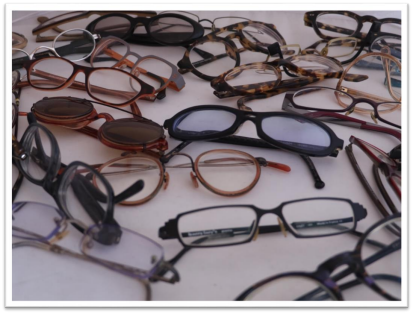
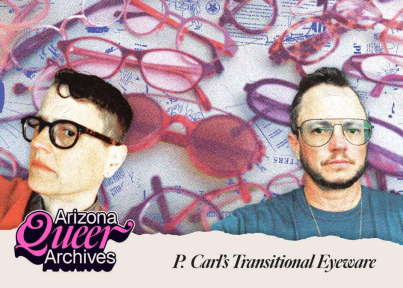
A close up I took of P. Carl’s collection that was used by design student, Ashley Gehrrmann for the new AQA postcards. Below, is the postcard designed by Gehrrmann. They also designed ones featuring Adobeland, AQA’s Zine Collections, Gay Community Services, and Southwest Feminists. All of these fun designs are available at the AQA, so grab a couple next time you’re visiting or reach out if you’d like one.
At the same time, I feel the work has given me new perspective on the nuances between digital and physical collections, as well as their disparate capacities for access. Touching archival artifacts and seeing them in person brings a new layer of context and affect that is more challenging to bring into a digital environment. Exhibitions have proven to be a key part of providing such access in my time working at the AQA. The last one that we hosted, “Let the Infinite Touch You,” loosely focused on queer connections “across time and space.” It took place in a small DIY space that opened this past year—a gallery that operates out of a small shotgun style house. We used picture frames to protect the more delicate materials, and displayed them on the walls, played a recording of Curt Stubb’s poetry on loop that echoed throughout the space, and laid out various publications on tables lined with brightly colored cloth. The goal was to embody a sense of “home” or familiarity— a way of both working with resources we had at hand and pushing back on the ways that institutions are inherently inaccessible. On the wall, my colleague Jules hand wrote a prompt as a way to draw people in as they connected with materials, inviting them to: “look for yourself in the archive, look for your friends…”
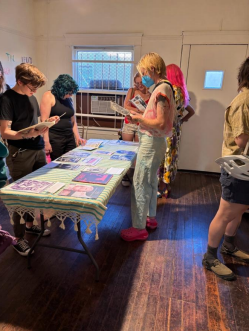
From “Let the Infinite Touch You”, a one-night exhibit hosted at Free Space this past May. You can read more about the exhibit on the AQA’s Substack in a recent post by Eric Reed here.
Exhibits open up a space for play—how do we bring this into the everyday? How can we consider creating similar types of engagement and access through digital platforms? In some ways, I see this reflected already in the AQA’s website, and in the work being done by other community archives. These are mostly questions I pose to myself, as I move from being a student into a future archivist/librarian.
As I sign off, I want to thank those who have invited me into the Archives to process alongside them. Thank you Jamie, for your trust and mentorship. Thank you Ames, for joining Jamie as co-director and continuing this important work. Thank you to Jules Baldino and Maria Torres for inviting me to join you in the beginnings of open hours, and for your encouragement. Thank you Eric Reed for your thoughtful insights, endless support, and writing about the work we all do on Substack. Thank you to Cosmo Brusa Zappellini—who joined me in the archives every Tuesday this last semester—for exploring more of the digital collections and sharing your editing knowledge. I am grateful to continue to be a part of this journey in some small way, and look forward to the future of the AQA.